01 / Our cosmic address
Beyond the Observable Universe
We began on one small world orbiting an ordinary star. Yet above us stretches a cosmos so vast that humanity has only begun to understand it.
We can observe only the part of the universe whose light has had time to reach us. This region is known as the observable universe. But is it everything that exists, or is there something far beyond what we can see?

The journey starts here
From the planets around our Sun to the largest structures we can observe, each discovery gives us another piece of the cosmic puzzle. But the farther we look, the more questions appear.
The cosmic horizon
The Observable Universe
The observable universe is the region of the universe from which light has had enough time to reach us since the early universe. Because light travels at a finite speed and the universe has a finite age, our observations are limited to a cosmic horizon.
Is that the edge of everything?
Not necessarily. The observable horizon is the limit of what we can observe, not a confirmed physical wall or the edge of the entire universe. There may be regions beyond it whose light has not reached us.
The observable universe extends much farther than 13.8 billion light-years in radius because space itself has expanded while the light was travelling toward us.
The limit of what we can see is not automatically the limit of what exists.
Humanity's farthest messenger
The Limits of Space Exploration
The observable universe is currently expanding, and some distant regions are moving away from us so rapidly due to this expansion that we cannot physically reach them. Scientists and cosmologists have been studying the universe for centuries, yet despite the progress we have made, we still do not know whether our current technology and spacecraft are capable of overcoming the physical limitations that prevent us from exploring these distant regions. Could future discoveries in physics change what we believe is possible?
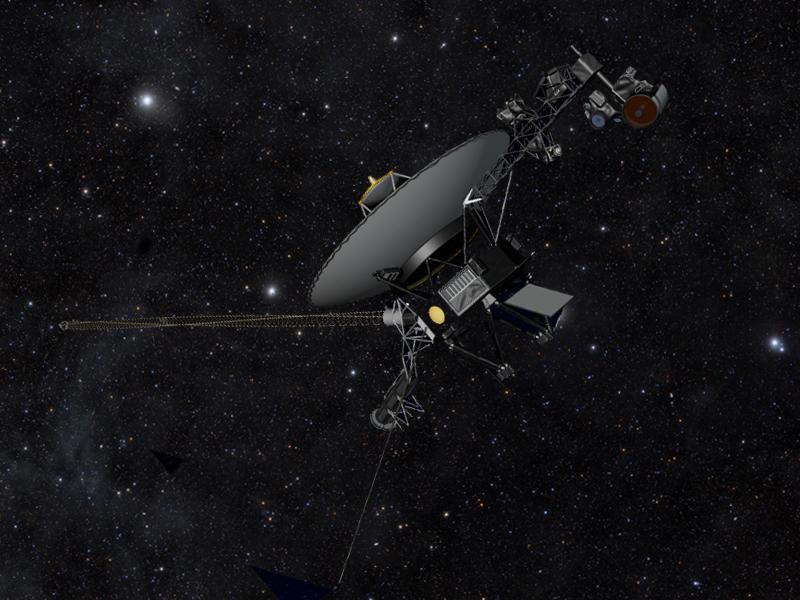
A machine from Earth, travelling between stars
Voyager 1 launched in 1977. It explored Jupiter and Saturn before continuing outward, eventually entering interstellar space. It is an extraordinary achievement of engineering — but it is still travelling within our cosmic neighbourhood, not across the galaxy or toward the edge of the observable universe.
Even at enormous speeds by human standards, distances between stars are immense. And cosmic expansion adds another challenge: some faraway regions are not reachable by any spacecraft that travels locally at less than the speed of light.
We have sent machines beyond the planets. But how far can technology take us?
Theories at the frontier
What Lies Beyond?
If the observable universe is only the part we can see, what might exist beyond its horizon? Could there be countless galaxies that we will never observe, even with more advanced telescopes?
Possibility 01 / A much larger universe
The entire universe may extend far beyond the observable region. Some models allow an infinite universe, but its total size and global structure are not known.
Possibility 02 / The multiverse
Some theoretical ideas suggest that our universe could be one of many. These proposals differ from one another, and there is currently no confirmed direct evidence that other universes exist.
Possibility 03 / A question we cannot yet answer
We must separate what observations show, what scientific models suggest, and what remains speculation. A fascinating idea is not automatically a proven fact.
Imagination can suggest the next question. Evidence helps us decide which answers nature supports.
Where knowledge reaches its limits
The Questions That Remain
Does the universe have an edge? If it does, what would that edge mean? Could the universe be infinite, or is its true size simply beyond our ability to measure?
Does the universe have a boundary?
We do not know the full geometry and size of the entire universe. An expanding universe does not necessarily need to expand into an outside region. In cosmology, space itself can expand, increasing distances between faraway regions.
Can our minds picture the answer?
Human intuition comes from everyday experiences: objects have edges, rooms have walls, and journeys have destinations. The universe on the largest scales may not behave like the familiar objects around us.
Modern physics has explained many things about the cosmos, but important questions remain unanswered. Future observations and discoveries may help us understand more about the structure and evolution of the universe.
What if the problem is not only that we lack an answer, but that the question itself is harder to define than we thought?
A fossil light from the early universe
What Does "Nothing" Actually Mean?
The observable universe is approximately 93 billion light-years in diameter, and it has been expanding ever since the early universe. But if the universe began expanding, what lies beyond it? What might exist beyond the observable universe? Some hypotheses have explored the possibility of a multiverse, but this remains unconfirmed.
This may be one of the biggest and most complex questions ever asked in human history, and yet we still do not have a confirmed answer.
Some people suggest that beyond the universe, there is nothing. But what do they mean by… nothing? Nothing as in pure, pitch-black darkness?
Darkness is not the same as nothing
Imagine a room without furniture, with all the lights turned off. We cannot say there is absolutely nothing inside, because the room itself still exists, surrounded by walls and boundaries. Darkness does not mean the absence of space.
So what if space itself is similar? What if we are imagining an absence of everything when we have not even established whether such an absence is possible?

The afterglow of the early universe
The cosmic microwave background is ancient radiation released when the universe became transparent, roughly 380,000 years after the Big Bang. It is not a photograph of the universe's edge; it is a scientific clue about the universe's early history.
Perhaps the question is not simply what lies beyond the universe, but whether the concept of "beyond" even makes sense when we are talking about the entirety of space itself.
At the edge of what we know
The Answer to the Unknown
We have explored our Solar System, the limits of spacecraft, the observable universe, and the possibilities that may lie beyond it. We have asked what "nothing" means and whether there can even be an outside to all of space.
Despite everything we have discovered, everything we have studied, and everything we have accomplished, we still do not have all the answers to the mysteries of the universe.
We have explored possibilities, developed theories, and pushed the boundaries of human knowledge. Yet some of the biggest questions remain unanswered.
And perhaps the most honest answer we can give today is not a theory, not a prediction, and not a guess.
THE ANSWER IS...
We do not know just yet.
And that is not the end of discovery. It is where the next question begins.